
Precision Gaging for New Energy Vehicle Motors
Paul Richards – Vice President of Engineering, Adcole LLC
Why Sub-Micron Metrology Is Becoming Mission-Critical in Hybrid and Electric Powertrain Manufacturing
The rapid expansion of New Energy Vehicles (NEVs), including battery-electric, hybrid, and plug-in hybrid platforms, has fundamentally reshaped the metrology requirements for rotating powertrain components. While electric propulsion eliminates many of the mechanical complexities associated with traditional internal combustion engines (ICE), it introduces a new set of challenges driven by extreme rotational speeds, tighter NVH expectations, and far less tolerance for latent manufacturing variation.
Modern electric traction motors now operate well beyond 20,000 RPM. At these speeds, micron-level deviations in geometry or surface integrity can manifest as audible noise, premature bearing wear, or long-term durability issues. As a result, metrology is no longer a downstream verification step, rather it has become an essential element of process control, manufacturing optimization, and overall vehicle performance assurance.
High-Speed Electric Drivetrains Demand a New Level of Precision
As rotational speeds increase, so does sensitivity to subtle form and surface errors. Parameters that may have been acceptable or effectively invisible at lower speeds now become dominant contributors to vibration and noise. Critical characteristics such as roundness, concentricity, runout, eccentricity, and surface-induced chatter must be tightly controlled to ensure quiet operation and long service life.
Traditional size-only inspection methods are insufficient for these demands. NEV manufacturers require full-profile measurement capabilities that evaluate not just diameters, but complete form behavior across the entire part. This includes straightness, taper, angular location, axial relationships, and surface texture, all with repeatable, sub-micron accuracy. Without this level of insight, manufacturing issues often remain undetected until they surface in downstream testing or, worse, in the field.
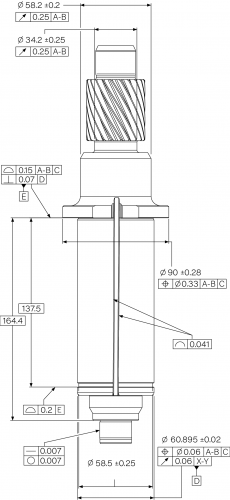
Automated Cylindrical Metrology for Critical NEV Components
Automated cylindrical coordinate measuring machines (CCMMs) have emerged as a cornerstone technology for NEV manufacturing. These systems are engineered to collect high-density measurement data across an entire rotating component while maintaining the throughput required for modern production environments.
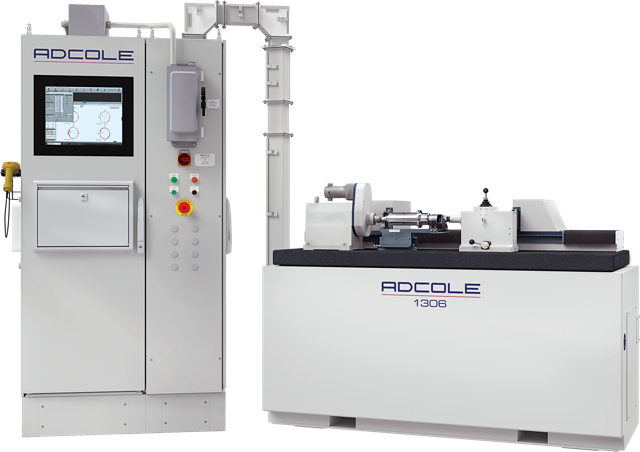
Adcole Model 1306
Horizontally loaded, multi-head, tactile CCMM platforms such as the 1300 Series by Adcole enable rapid, single-cycle inspection of electric motor rotor shafts, pinion shafts, and shaft assemblies. Multiple measuring heads operating simultaneously allow manufacturers to evaluate diameters, total indicated runout, straightness, crowning, center deviation, perpendicularity, face measurements, and taper without sacrificing cycle time. Integrated part and ambient temperature monitoring further enhances accuracy by compensating for thermal effects that can otherwise distort results.
Beyond geometry, these systems also detect surface convexity or concavity, ridge formation, high-frequency surface undulations, and lobing on bearing journals. This level of measurement detail gives manufacturers actionable insight into machining health and process stability, rather than a simple pass/fail outcome.
At 20,000+ RPM, a “good diameter” with poor roundness or subtle chatter can still generate unacceptable vibration and noise. High-speed electric motors demand a holistic measurement approach that captures form, surface, and angular behavior—not just size.
Measuring Laminations, Gears, and Hybrid Assemblies
NEV powertrains rely on more than shafts alone. Laminated rotor stacks, gears, and splines all require precise alignment and geometric consistency to function as an integrated system.
Advanced CCMM platforms support angular measurement of lamination stacks, verifying the position of axial grooves relative to defined datums. This ensures proper phasing across the assembly which is an essential requirement for torque balance and efficiency.
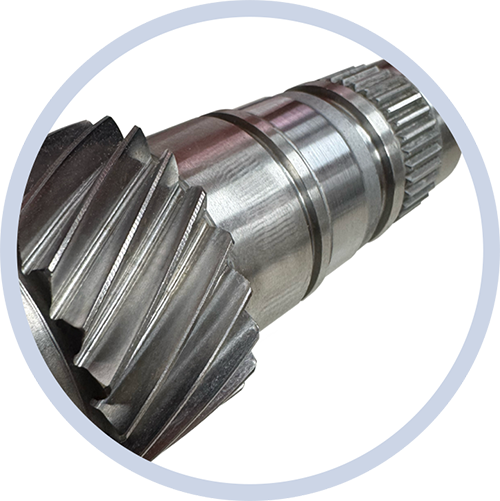
For gears and splines, specialized follower designs enable measurement of in-and-out deviations across both vertical and helical tooth forms. These measurements support accurate determination of gear diameter, total radial runout, and face-plane variation, even on interrupted surfaces. The resulting roundness and runout plots provide valuable feedback to machining, grinding, and assembly processes.
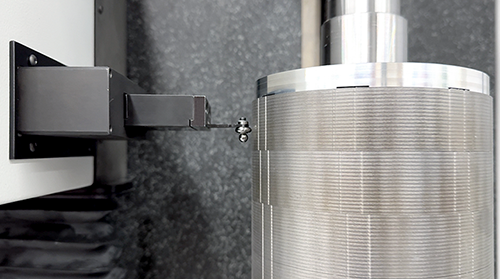
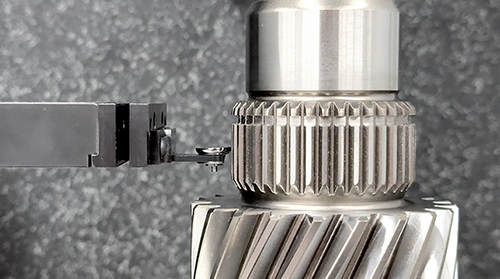
Roundness measurement on rotor splines
Chatter: A Hidden NVH Risk in Electric Motors
Among the most significant and often underestimated risks in NEV manufacturing is chatter. EV motors operate in an acoustically quiet environment, meaning even extremely small, periodic machining marks can become audible to the end customer.
These sub-micron-scale surface patterns, often missed by conventional surface checks, are amplified at high rotational speeds and manifest as vibration, bearing wear, and tonal noise. Tactile gaging systems combined with real-time FFT chatter analysis using tools like Adcole Chatter Analysis Software capture the harmonic “fingerprint” of these patterns directly on the shaft surface.
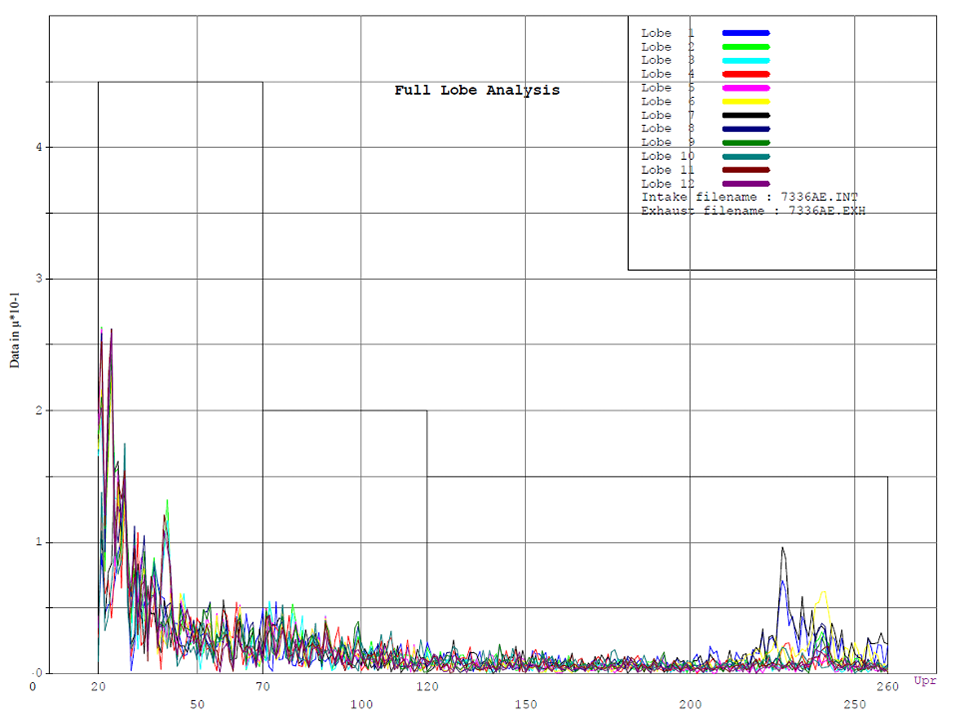
Lobe chatter data over the full 360 degrees of profile error data. The amplitude of the chatter gets muted (damped) when looking at the full 360 degrees compared to looking at just the base circle region.
By analyzing undulations per revolution (UPR) and isolating specific frequency bands, manufacturers can trace chatter back to its root cause such as a grinding wheel condition, dressing parameters, or process instability. This enables corrective action before parts move further down the production line.
Advanced chatter analysis transforms surface data into frequency-based insights, allowing manufacturers to detect and correct process instability long before NVH issues appear in vehicle testing or the field.
Surface Finish Measurement Solutions
As efficiency and durability targets rise, surface integrity requirements for NEV components have become increasingly stringent. Automated surface roughness systems like the Adcole Model 1000 and 1000-Z provide high-density tactile measurement across multiple journal and bearing surfaces, capturing thousands of data points per millimeter for repeatable results.
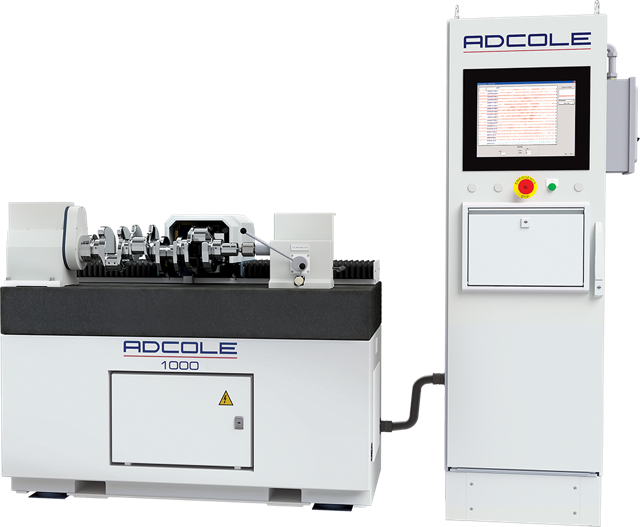
Adcole Model 1000
Hybrid tactile-optical systems extend this capability further by incorporating non-contact interferometric measurement. These systems enable three-dimensional surface analysis, waviness detection, and evaluation of features that are inaccessible using contact probes alone.
Turning Measurement Data into Process Intelligence
The true value of advanced gaging systems lies not only in data collection, but in how that data is analyzed and applied. Modern metrology software converts raw measurement results into actionable insights that support continuous improvement.
Three-dimensional color mapping highlights localized form errors and non-conformities that might otherwise go unnoticed. Advanced straightness and material build-up analysis distinguishes true form deviation from surface contamination, reducing false rejects and unnecessary scrap. Real-time FFT chatter analysis links measured defects directly to manufacturing dynamics, closing the loop between inspection and process optimization.
Why CCMM Remain Critical in a Hybrid World
Despite rapid growth in fully electric platforms, hybrid vehicles represent a structurally important segment of the automotive market that meets the demands of a large portion of consumers. Hybrids still derive a significant portion of their propulsion energy from internal combustion engines while delivering significant gains in efficiency, range, and emissions performance.
For decades, CCMM solutions have been the benchmark for measuring camshafts, crankshafts, and other high-precision ICE components. Parameters such as lobe geometry, journal accuracy, phase angles, runout, and concentricity are often measured to sub-micron ranges on features that can directly influence combustion efficiency, NVH behavior, and durability.
Hybrid powertrains intensify these requirements. ICE components experience frequent start-stop cycles, rapid torque transitions, and broader duty cycles driven by interaction with electric motors. CCMM platforms developed for camshaft and crankshaft inspection are uniquely equipped to meet these challenges, providing a comprehensive view of part behavior rather than isolated dimensional checks. That’s why platforms like the Adcole 1200‑LX, 1100 Series, and 911 Series are engineered to meet these challenges and help improve the quality, durability, and lifespan of critical ICE components that are becoming even more demanding with the rise of hybrid powertrains. Instead of providing isolated dimensional checks, they deliver a comprehensive understanding of part geometry and behavior that is required to ensure reliability in modern hybrid and ICE applications.
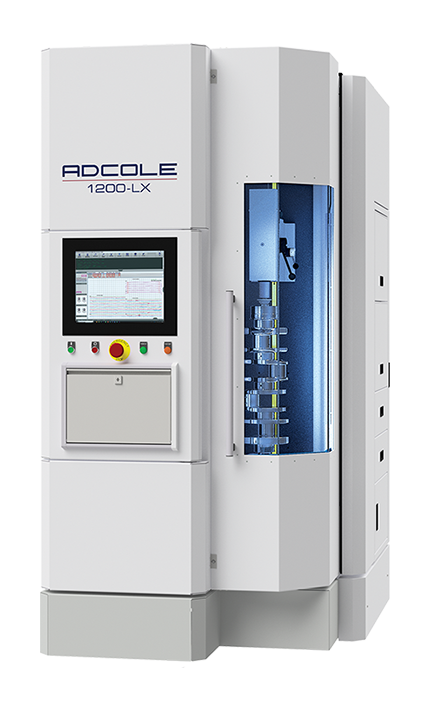
Adcole Model 1200-LX with Laser Interferometry Measurement
Equally important, analytical techniques refined through decades of ICE metrology such as high-accuracy roundness evaluation, advanced straightness analysis, and harmonic chatter detection translates directly to modern hybrid and electric components. Legacy ICE expertise does not compete with electrification; it enables it.
1960s–1980s: Automated camshaft and crankshaft inspection establishes sub-micron form measurement
1990s–2000s: Emissions and NVH requirements drive advanced chatter and straightness analysis
2010s: Hybrid architectures expand duty cycles and tighten tolerance requirements
2020s–Present: Proven ICE metrology methods underpin high-speed EV motor inspection
Precision Metrology as a Strategic Advantage
As NEV and hybrid platforms continue to evolve, tolerances will only tighten and performance expectations will continue to rise. Manufacturers that treat metrology as a strategic capability rather than a compliance exercise can gain a meaningful advantage in quality, efficiency, and long-term reliability. High-accuracy CCMM systems, advanced surface analysis, and data-driven inspection software enable organizations not only to verify parts, but to understand and control the processes that create them. In an era defined by high speeds, quiet cabins, and uncompromising durability expectations, precision gaging has become a foundational element of successful NEV manufacturing.