
Supporting the AI Economy: The Role of Precision Metrology for Large Power Generation Engines
Why Automated Large-Shaft Measurement Is Critical in the Age of AI Data Centers
Paul Richards – Vice President of Engineering, Adcole LLC
Artificial intelligence is rapidly becoming one of the largest drivers of global electricity demand.
According to the International Energy Agency, global electricity consumption from data centers, driven largely by artificial intelligence workloads, is projected to more than double by 2030, rising from roughly 415 terawatt-hours in 2024 to about 945 terawatt-hours annually (Source: IEA: Data center energy consumption set to double by 2030 to 945TWh – DCD). Some projections estimate that AI-focused data centers alone could require hundreds of terawatt-hours of additional electricity annually, rivaling the total power consumption of some industrialized nations.
Meeting this demand requires large investments in new and expanded power generation capacity. Utilities, infrastructure providers, and hyperscale technology companies are rapidly deploying large-scale generator systems capable of producing several megawatts of continuous power per unit. Natural gas, diesel, and dual-fuel engines remain critical components of this energy infrastructure, providing reliable baseload and backup generation for energy-intensive data centers.
The generator systems powering modern energy infrastructure contain crankshafts and camshafts that often far exceed 1.5 meters in length and weigh over a ton. These parts must run continuously under heavy load for tens of thousands of hours while holding tight dimensional tolerances that are essential for efficiency, reliability, and vibration control. Even slight micron level deviations from manufacturing tolerances can create vibration, accelerate bearing wear, and degrade overall performance. As generator outputs rise and duty cycles grow longer, maintaining the dimensional integrity of these components has become increasingly critical.
The Metrology Demands of Large Power Generation Shafts
Measuring parts of this size presents significant metrology challenges. Traditional inspection methods struggle with repeatability and accuracy at this scale with measurements that can take hours to complete, and the sheer mass of the components introduces handling and safety concerns on the factory floor. To overcome these limitations, manufacturers now rely on specialized automated cylindrical coordinate measuring machines (CCMMs) designed specifically for large crankshafts and camshafts. These systems deliver precise geometric verification while performing more comprehensive measurements in a fraction of the time of manual methods. This results in production that helps ensure long-term reliability of power generators and supports the high demand of engines driving today’s AI-powered energy landscape.

Despite the massive scale of these components, they must still meet extremely tight tolerances across complex geometric features. Critical parameters measured include:
- Journal diameters
- Roundness and cylindricity
- Runout and concentricity
- Straightness and taper
- Index angles and phase relationships
- Lobe geometry and timing
- Bearing alignment and journal positioning
Unlike smaller automotive components, the mass and length of power generation shafts introduce additional challenges during measurement. Deflection, inertia, thermal variation, spindle stability, and the large dimensions of parts being measured can all affect results if the gaging system isn’t engineered to manage these variables. A robust control system must tie all of this together to ensure each motion axis works in concert together with precise feedback on positional accuracy of the headstock spindle, carriage axial locations, and follower probe positioning.
Traditional coordinate measuring machines and general-purpose metrology tools simply lack the rigidity, spindle capacity, and rotational precision needed for components of this scale. For this reason, specialized CCMMs purpose-built for large rotating shafts are essential to achieve accurate, repeatable measurements in a fraction of the time compared to traditional methods.
Supporting Large Parts That Weigh More Than a Ton
Gaging systems designed for power generation applications must address three fundamental challenges: (1) supporting and rotating parts of extreme mass, (2) enabling a control system that can rotate heavy parts and locate follower/probes to precise angular, axial, and radial positions, and (3) maintaining sub-micron measurement accuracy along extreme part lengths and radial positions. Large-shaft CCMM platforms accomplish this through specialized controls and mechanical architectures that maintain rotational precision under heavy loads. In particular, the headstock spindle, the rotating axis that drives the shaft during measurement, plays a critical role in ensuring both stability and accuracy.
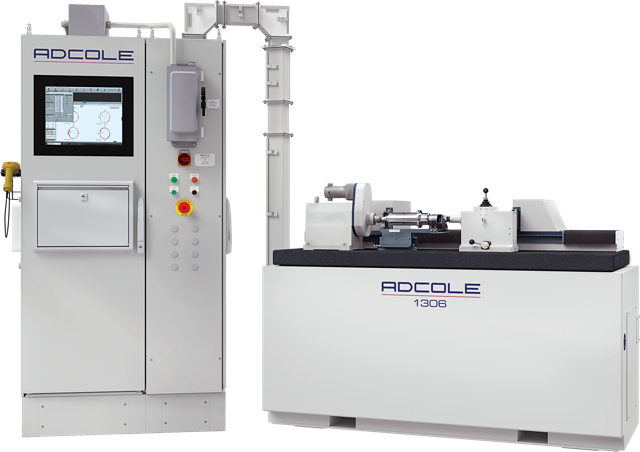
Adcole Model 1306
In a high capacity metrology system, the headstock spindle often has more influence on measurement accuracy than any other component as it must support loads exceeding one ton while minimizing variability, such as spindle runout, that can impact measurement precision. Achieving this requires spindles manufactured to extremely tight tolerances and integrated carefully into the machine’s structural framework to lessen any impact on metrological performance.
Why Large-Shaft Metrology Is Different
A crankshaft weighing over a ton cannot simply be measured on a conventional CMM. Large rotating components require specialized CCMM platforms with heavy-duty spindles, rigid mechanical structures, and rotational measurement systems designed specifically for high-mass parts.
Data-Driven Quality Control for Power Generation Components
Modern large shaft gaging systems do far more than confirm dimensional compliance; they generate rich datasets that drive process optimization and predictive manufacturing. Advanced metrology software transforms raw measurement data into meaningful insights through roundness visualizations, profile maps, and harmonic frequency analysis. These tools reveal subtle geometric patterns that point to upstream process variation, allowing engineers to identify issues early and make targeted adjustments before defects spread through production.
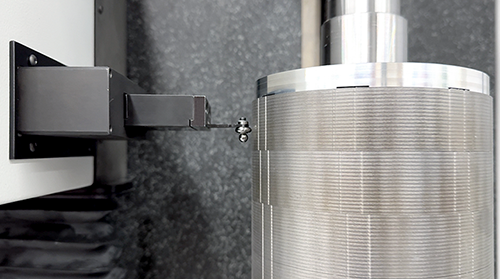
For manufacturers of large power generation engines, this level of diagnostic capability is essential. A single non-conforming crankshaft can trigger costly delays, rework, or even worse with field failures in continuous duty generator applications. By combining automated measurement with sophisticated data analytics, today’s CCMM systems ensure every shaft meets the demanding reliability standards required for long-life, high-load operation.
Detecting Lobing and Chatter in Large Crankshafts
Among the most significant and often underestimated risks in NEV manufacturing is chatter. EV motors operate in an acoustically quiet environment, meaning even extremely small, periodic machining marks can become audible to the end customer.
Lobing refers to deviations in roundness that occur in periodic patterns around the circumference of a journal. These deviations can disrupt hydrodynamic lubrication conditions, increasing bearing stress and reducing service life.
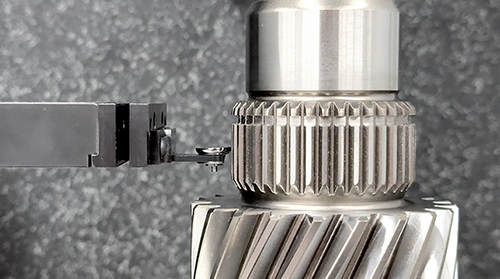
Chatter, typically introduced during grinding operations, appears as high-frequency surface undulations. While often microscopic in scale, these patterns can produce measurable vibration once the engine is in operation. In large power-generation engines, such vibration can propagate through the entire system, affecting efficiency, increasing wear and maintenance costs, and ultimately affecting the life of the engine.
Roundness measurement on rotor splines
Chatter in Large Shafts
Even micron-level grinding marks on large crankshafts can produce measurable vibration in power-generation engines. Detecting chatter during inspection allows manufacturers to correct machining processes before components reach assembly.
By capturing dense roundness profiles and applying frequency based analysis, advanced CCMM’s can identify harmonic signatures associated with lobing and chatter. Specialized software can correlate these signatures to machining parameters such as grinding wheel condition, dressing routine, or machine tool instability that can allow engineers to trace defects directly back to their source. When this measurement data is aggregated across multiple parts, facilities gain powerful insights into process trends, tool wear patterns, and long term equipment health, enabling predictive maintenance and continuous improvement throughout the manufacturing line.
Precision Metrology as a Competitive Advantage
Manufacturers of large crankshafts and camshafts face a distinct challenge: achieving micron level precision on components that can weigh more than a car. Meeting this standard requires not only advanced measurement technology but automated gages specifically engineered for large rotating parts. Large shaft CCMM platforms provide this capability though machines engineered to combine core metrological expertise with structural rigidity, robust control systems, high capacity spindles, and sophisticated analytical software to deliver the accuracy modern power generation engines demand.
As global electricity needs grow, driven in part by expanding AI infrastructure, the ability to produce reliable large engine components becomes increasingly critical. Precision metrology sits at the center of that reliability, ensuring every shaft performs as expected in the continuous duty applications that keep today’s energy systems running.